Tuesday, 27 September 2011

Spies and the cold war

Most embassies have them: they are the peacocks of the diplomatic cocktail parties in their number 1 uniform, chests covered in medals. They are, of course, the military attachés.

What do they do? Well there are certain liaison jobs to be done for countries with soldiers in the UN peace-keeping force here. But that’s hardly a full time job, and not nearly as glamorous as being a spy, so spying it is.

Of course the actual spying is done by other people, the assets. The game is to have as many assets as possible, spread throughout the country. But once one has an asset there are three problems: the first is to know how trustworthy he is (is he really on our side?), the second is to know how accurate his information is (does he know what he is talking about, or is he making it up?) and the third is how and how much to pay him. And if you have 200 or so assets, that’s enough to keep you pretty busy.

The first two questions can be resolved by treating his information with much caution for the first year or so, and cross checking it with other people. That soon sorts out the good ones from the bad. It needs patience, but is essential. The third one is a serious problem for three reasons. The first is that one doesn’t want to have any traceable link with the person concerned. The second is that one must minimise the occasions when one meets. The third is that in a big country like this one just to make any arrangements to send cash are very complicated.

So when you see the Military Attaché drawing several thousand dollars at the embassy cashier ask no questions and get no lies. It is thus that he travels to remote corners, pockets stuffed with dollar bills, the Father Christmas of the assets community, bringing them relief after months without payment.

As for results: is it worth it? Who knows? Obviously these assets are the source of the rumours which plague the embassy circuit. There’s going to be an uprising in Lubumbashi tomorrow; so and so is going to be arrested and there’ll be huge demonstrations near the airport; the army haven’t been paid in the Eastern provinces for three months and they are going to mutiny, etc etc. About one in three of these rumours turns out to be true, but true or false the spy community can feel good because they’ve protected their nationals from danger. As an added bonus, the information can be fed to the political guys who like to know more who want to know more about the huge number of factions within the army: who is leading them, what they are doing and what they plan to do. And, the Ambassador needs to get inside information about what political parties are doing.

Not all spies are the gentlemanly military attachés. You meet some really rough ones, who usually present themselves as being in the security business, or having a completely unbelievable role in the embassy such as the legal advisor to the military court, while hardly being able to put together a sentence. These are the thugs of the spy world, who will not hesitate to put people out of their misery when circumstances require it. “No, nothing frightens me. This country is just like the rest – make sure they know who’s boss and you’ll be all right . . .” One can’t help wondering whether Simon Mann used to say things like that before trying to topple the government of Equatorial Guinea.

I was fascinated to meet someone from what was clearly a similar background and who now runs a business in Kinshasa. He said he quickly learned that attack is the only form of defence that works here. He gets frequent visitors who claim to be collectors of this or that tax, or to have found fault with his labour practices for which he will be fined.

His technique is simple. He has documentary proof of having paid all his taxes so is confident that no one can get him on that. He pretends to speak no French, but politely, but very firmly and without ceremony shows them the door. They never come back. In a recent case where the Minister of Labour instructed him to reinstate an employee he wrote a letter to the Minister stating that he had invested x amount, and employed y many people and he had no intention of being told what to do by a Minister who had no financial stake in the business. It worked.

Of course, you need to be pretty sure that you’re right before using those tactics, but how? Of course, you too have spies, a network within the government who can tell you what’s going on, who is powerful, who is not, and so on. And, gathering information that you can use against them if they get nasty. So business spies here are not about industrial secrets, but protecting your position.

It suddenly dawned on me: the DRC has its own war. On the one side, the “West” trying to make a success of a business; on the other the “East” trying to maximise its income from bribes and taxation. Yes, it is war, a cold one maybe, but war nonetheless.

Thursday, 22 September 2011

Death by Zealot

The good people of the so-called developed world are concerned about environmental damage by development, climate change due to de-forestation and all that. They are right to be so concerned. But I wonder if they realize how their good intentions are interpreted by zealot bureaucrats in remote places. As those bureaucrats see it, they have a duty to follow the law, and anyone found approving projects which have not followed the Federal environmental procedures will get a serious slap on the wrist or worse.

Now here’s a good project: clearing a road which had been built decades ago but which had become impassable due to fallen trees, dilapidated bridges etc. Using village labour at a cost of a few thousand dollars we can clear enough road to allow bicycles through and thereby allow the residents of many villages to bring their produce to market. What possible argument could there be against this project? Indeed it was approved by a careless, rebellious or maybe simply well-intentioned person in the office of a respectable development agency. But he shouldn’t have approved it, and received a written reprimand for allowing it through. Had he not considered that opening such a road could allow more poachers to kill the animals in the forest? And that it could cause erosion? Etc etc? A full-fledged Environmental Impact Study should have been done (at a cost far greater than the project itself).

This sad story repeats itself daily. We are offering small grants for infrastructure improvements. A particular favourite is to build toilets so that school children do not have to go behind the bushes. A very sensible public health intervention, one would think, reducing the risk of spread of disease very substantially. NOT ALLOWED! Have you thought about where the effluent will go? Have you thought about the impact of construction activities on previously undeveloped land?

Another favourite is to rehabilitate classrooms by replacing the roofs and plastering the walls. NOT ALLOWED! Have you considered the extra run-off from the metal roofs? Have you thought about the impact that the construction labour might have on the locality?

One could (should?) fight back. One should point out, for example, the risks of cholera and worse that the present conditions present; or the fact that a few square metres of roofing will make the difference between going to school and not going to school for many children. One should argue that such little projects, a tiny drop in the ocean for a development agency, mean a tremendous amount to the poor villagers. Yes, but . . .

The person who rejected our little projects may well, privately, have had the same view, but to her the law had to be followed. No amount of discussion is going to change her decision: the law is the law. She had a duty to stop these projects: the environmental risks were, according to the official guidelines, too high.

Eventually we got the matter raised at a higher level, and her decision was, much to her chagrin, overturned. It was agreed that, in order to comply at a token level, we could do a community-led environmental impact assessment.

Meanwhile, the grievance felt by the person whose decision was overridden may come back to haunt us: she has other ways of throwing her weight about.

Monday, 19 September 2011

The frog in the pan

We were talking to the head of one of the biggest donors to the DRC. It was the day before he was to leave after three years at the helm in Kinshasa: a time for reflection.

“Do you know the phenomenon of frogs?” he asked. “If they accidentally hop into a pan of very hot water, they’ll jump out instantly. But if they’re sitting in the water, and it is gradually heated up they just sit there, totally passive, until they die. That’s why it’s time to get out. I’ve just come to accept that nothing will work here.”

It was with those words still in our minds that we went away for a week end to a spectacular waterfall about three hour’s drive from Kinshasa. We had been told that it was very nice, but nothing prepared us for the extraordinary quality of the rooms which we and two other families were to occupy. The spacious design, with a wooden deck overlooking the falls, the quasi-Indonesian style and the immaculate fittings demonstrated that one did not always have to put up with shoddy workmanship, bad design and decrepit fittings and linen which we have come to see as typical of the Congo. This was truly world class accommodation, and while expensive was probably in line with international prices for such accommodation and location. We had two bedrooms, a living room with a deck over the river, two large bathrooms each with an outside shower and a small kitchen facility with mini-bar. $500 per night for four people didn’t seem bad.

There was only one problem. The showers in one room didn’t work and in the other the pressure was very very low and the hot water ran out. We complained to the very attentive man, Albert, who seemed to be looking after our rooms. “I’m so sorry to hear about that,” he said, “I’ll get a technician to put it right immediately.”

His optimism was misplaced, because that evening and the next morning we had the same problem, if not worse. The following evening it was the same again. Luckily we could use the bathroom in the other chalet, so it was less of a disaster than it might have been. After repeated reminders that the water was still not working, we, like the frog in the ever-heating water, gave up.

When it came to check out we complained. “Why, that’s the first we have heard of it,” they said, “You should have complained at the time.” Albert, apparently was the wrong person to complain to, but irrespective of that our complaints seemed to fall on deaf ears. Eventually we prevailed, and a little trip to our chalet was arranged so that we could show the management what the problem had been. But, as luck would have it the shower worked perfectly, and we felt a little foolish. Obviously Albert had actually done something this morning.

Although the wind had been taken out of our sails, they said we could raise the issue of compensation with the management in Kinshasa. But on the way back our resolve weakened and we had begun to wonder whether it was worth making such a fuss, and whether we had been quite fair to be so cross. What would be the point? We might wangle a free night out of it, in compensation, but with little or no water . . . etc etc. But two days later everything changed. She who must be obeyed ran into a friend who had been there the previous week-end in the same rooms as us. “It was so nice,” she said, “but we had no water. . .”

Friday, 16 September 2011

Wild Polio

That’s the name they give these days to polio caught from someone else. Apparently it is very infectious, and as we all know can have horrible results. So when wild polio was detected in Brazzaville, a mere 1000 metres from Kinshasa, alarm bells rang.

Readers will know that public administration is not the Congo’s strong point. In brief nothing works well, so when the authorities mentioned, in quite a causal way, that they would mount a polio vaccination campaign we all raised an eyebrow and muttered the usual sceptical noises.

I first realised something was actually happening when someone in the office, a week later, said “They’re here. Everyone must go.” I must say, my first reaction was that this was some sort of money-making trick. But there they were: two young people with little satchels bearing the UNICEF logo, dishing out polio vaccine. I was one of the few not to need it, as I had had one before coming.

Two days later in the evening we were at one of the big Lebanese owned supermarkets. Just outside there was another team, quietly offering vaccinations to everyone who came by. They came to the house, they went to factories and building sites, they stood at the ports. They went to houses, schools and hospitals in rich and poor areas. They were everywhere. And when you met them, they were so polite and helpful it was a pleasure to talk to them.

Two things completely amazed me. The first was the way in which the campaign was organised, with a minimum of slogans but a maximum of face-to-face contact, which is what really works. The second was the sheer scale of the operation, and the speed at which it had been organised.

As I understand it, the young people carrying around the kits were all volunteers, recruited by the Red Cross and other NGOs. I imagine the churches were also involved. Each volunteer received a token payment to cover transport costs and that was all.

Whatever method was used, there can be no doubt about the results. Within two weeks most residents of Kinshasa, more than 8 million of them, had been vaccinated. The wild polio epidemic was stopped in its tracks.

UNICEF and the WHO were involved, and many international donor groups supported the operation. Moreover, polio vaccination has the delightful simplicity of not requiring jabs. But it worked and it was a Congolese operation, so if anyone makes a sneering comment about how they couldn’t organise a piss-up in a brewery, you know they are wrong.

Sunday, 4 September 2011

Soliloquy on a pee

We were more than half way through a long, very bumpy and dusty journey of six hours. My colleague from Mali had drunk a lot of water before leaving and needed a pee. Why not me too? I thought, so I hopped out to do the same, and found a spot where I was semi-hidden by very tall thick grass. I didn’t want to penetrate too deeply because the grass was coated in thick red dust.

Before I could finish, I heard someone shouting “Monsieur.” The voice came closer. “Monsieur, Monsieur.” Someone seemed to be addressing himself to me. I turned around to see an armed policeman advancing towards me – though not a particularly impressive one, I couldn’t help noticing. His blue uniform was crumpled, his face very wrinkled, and he seemed to find the weight of his machine-gun burdensome.

“Monsieur, that’s not allowed,” he said.

“Oh, I’m sorry,” I replied, and went to get back into the car.

“Oh no. You must come with me.”

By this time he had been joined by another, younger policeman. I thought he would tell the silly old man to let me go, but no: he stood there in solidarity with him, gripping his machine gun in a menacing way, and saying nothing. I noticed his gun was bigger and newer than the old man’s.

“I’m not going anywhere with you,” I said, “I’m getting in the car.”

A stern hand grasped my shoulder, and then the lecture began.

“Have you any idea how many of our women and children are dying every year because of people like you? There are public toilets but you are spreading disease and unsanitation (his word, not mine) everywhere you go. No wonder we are suffering so much. No wonder our hospitals are overflowing. It is people like you who bring disease to our country. If you want to go . . .”

He paused for breath, his old eyes bright with his eloquence, as a third policeman turned up also carrying a machine gun.

“If you want to go there’s a toilet over there.” He pointed to a little hut and toll barrier which we had not had to stop at as we are exempted. “There’s a toilet over there, there are toilets everywhere. That is what the government is for, to build toilets. But you, you white people, come here and pollute the landscape in this way. No wonder our women and children are dying. No wonder our hospitals are full . . .” and so it went for what must have been ten minutes. I was so impressed by his eloquence, which even if repetitive seemed to be heartfelt, that I felt like clapping. But I was equally impressed by his total lack of medical knowledge and was inclined to sit him down, or start a conversation on the lines of:

“Didn’t they teach you anything at school? Pee contains no germs. That’s why the Prime Minister of India used to drink it . . . etc etc.”

But somehow I don’t think he would have been interested or impressed, because the point of the spiel was only to emphasise the seriousness of my crime, which was, of course, an essential prelude to the demand for a huge fine.

Much to my relief, my Congolese colleagues now took over. All three policemen were taken to one side, and after much hushed discussion a fine of $5 was eventually paid.

It reminded me of a much worse experience which a Belgian colleague and her husband had had. They had decided to take a ride in a dug-out canoe on a river near Bandundu. Bandundu is a sleepy little town which is the headquarters of the Province, and which we visit frequently. Before setting out, they had carefully asked whether there were any formalities required and the boat’s owner had assured them that there weren’t. But when they got back to the shore they were met by a very officious person from the Immigration service.

“Where is your permit?” he asked.

“What permit?”

“To go on the river. You need authorisation from my office.”

He had obviously spied both money and weakness, because he made them go to his office where they were basically imprisoned as if they were spies. He kept on muttering about it being a very serious matter, which had to be dealt with by higher authorities and stuff like that. Eventually it was getting dark and he accepted $100 in settlement.

These stories are funny, especially in retrospect, but as I’ve too often pointed out it’s not just foreigners who are targeted. The ordinary farmer, market woman and street trader, for example, are constantly being hit on. That’s why a friend of mine came up with a new name for the country: “The Democratic Extortionate of the Congo.”

Friday, 26 August 2011

A new life


The airline industry in the Congo has the worst reputation of any in the world. A recent crash caused the government to ban the biggest operator from the skies. Another, apparently too successful one, operated by South African Airways, was closed down on a technicality. This has left one operator with a monopoly which it is enjoying all the way to the bank, with ticket prices rising daily in response to the huge demand.

Since the risk of a crash by all of the commercial operators is so high, none of us aid and diplomatic workers are allowed to use them, and must fly by the UN systems which were primarily set up by the peace-keeping force. Due to the loss of the SAA planes (which we were allowed to use) the pressure on flights to Lubumbashi is huge, particularly as it is not a town that needs either humanitarian or peace-keeping support. Thus it is that the journey from Kinshasa to Lubumbashi takes 1½ days, and about seven hours flying time as we wander around the country in little planes designed to deliver good works to villages.

The scene in Kinshasa, as we are checked in at 6.00 a.m. is tense. There are always more people than places. The passengers include the genuine and few peace keepers, pen pushers from the UN bureaucracy, who have to be seen to be doing something by travelling, and development and NGO types who are working for international donors. We eye each other slightly suspiciously, as if to say, why are you on this flight?

There are problems with the weight. One person who attracts a lot of interest has two large bags and a guitar. From the look of his youthful beard, the weak smile that he uses to disguise his fear, and his obvious uncertainty about what is happening, he is obviously a newcomer. The man operating the scales allows him through, even though he is almost 20kg over, as an act of sympathy.

We disembark at Kalemie, a place in the middle of nowhere, while the plane continues to Goma with most of the passengers. Our lank person with the guitar gets off. We have to stay overnight as our connecting flight to Lubumbashi is not until tomorrow morning.

The next morning is crisis time. For us, it was partly because (as recounted elsewhere) we arrived just as our seats were about to be given to desperate standby passengers. But worse was to come. The genial Moroccan soldier supervising everything told us that due to certain circumstances, they had to limit the luggage to 20kg including hand-carried stuff. No exceptions were to be made, not even for tools of the trade (my laptop).

Our lank hero, carrying everything he was to need for the next two years, had the dreadful job of choosing what to take and what to leave. He had been joined by two colleagues. One, an older Japanese man who insouciantly carried a satellite phone, but whose luggage was little more than a back pack; and a blue stocking French woman in her thirties. Between them they managed to share some of his excess, but after 30 minutes of sorting he was still fighting an unwinnable battle of dividing important from unimportant. The guitar was, of course, the first to go; but what about some books, spare pairs of shoes, shampoo? Where was he to get shampoo from, where he was going? My Congolese colleague was in a similar position. She had a veritable army of handbags and assorted luggage, probably mostly containing eatable bargains from Kinshasa.

The Moroccan explained that that plane was only half way through its biannual service, so wasn’t very powerful . . . so it was for our own safety that they had to impose these restrictions. They promised to send the excess baggage by the next plane, two days later. And not to worry – they promised nothing would get stolen.

The plane was very small: ten passengers, with the luggage strapped down on the floor at the back. No loo here, and no drinks service either. On the bulkhead was a placard proclaiming that the service was funded by the US, the UK, Canada, Spain and Mexico.

As the plane lumbered down the dirt runway, the Moroccan’s warning about the uncompleted service was ringing in our ears. It took forever to take off and I wasn’t the only one whose knuckles were white. Just in time the nose lifted off, and I’m still alive to tell the tale.

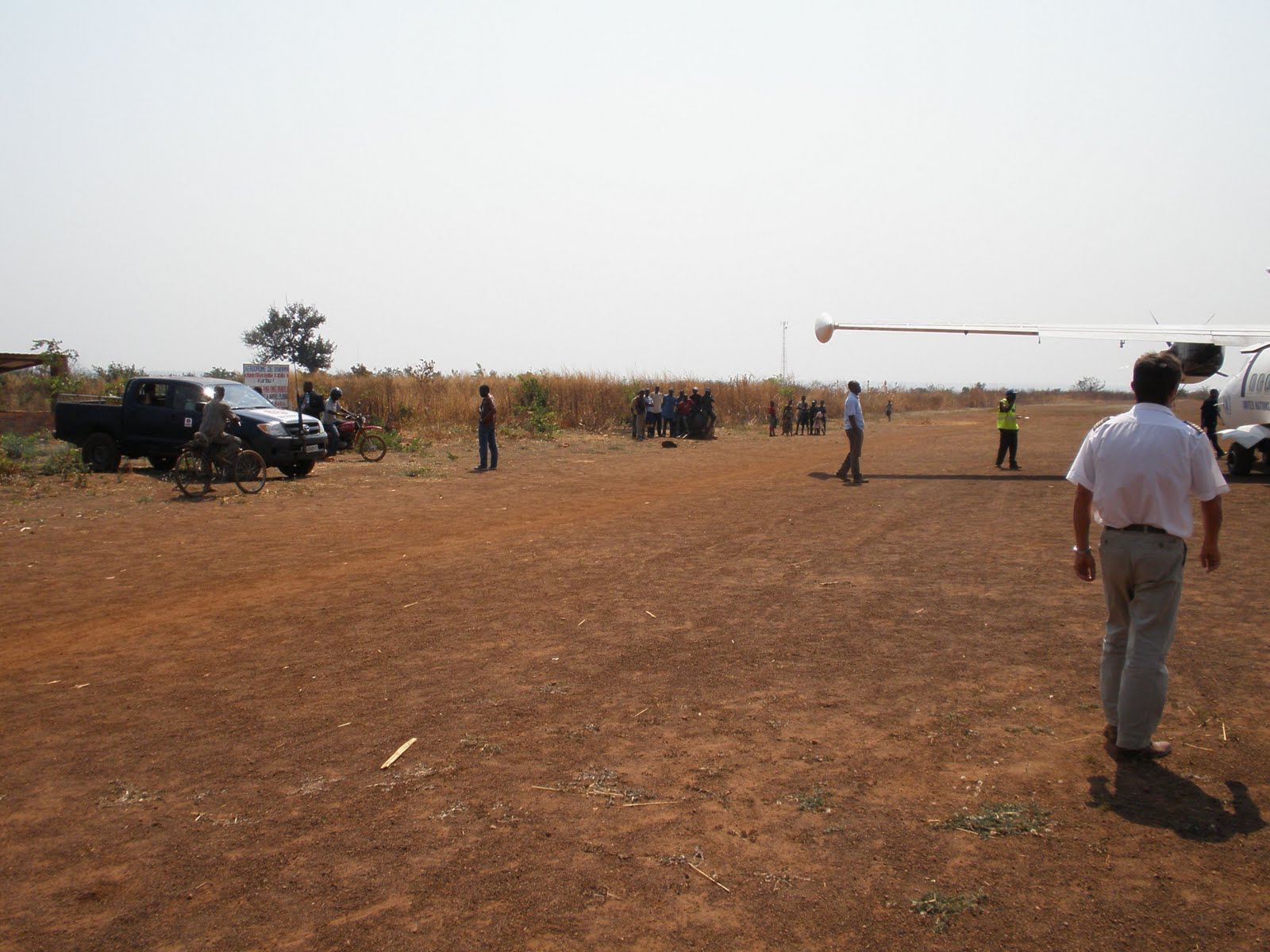
Two stops later we arrived at the tiny aerodrome of Bukama, pictured above, and our lank young man got off with his two colleagues. A pick-up truck was there to meet them: Soladarité International, proudly proclaimed the logo on its side (it describes itself as a humanitarian organisation based in France which aids war victims through emergency relief and rehabilitation).

As he hopped in you could see his relief at being transformed from being a helpless pawn in the game of UN flights, into a saviour of people’s lives.

Thursday, 25 August 2011

The Village

We are in Kalemie, the once thriving port of Albertville on Lake Tanganyika that has been marginalised by the lack of roads and a collapse of the railway system, and which I referred to as an impossible destination in a much earlier blog.

We are in the house of a colleague’s friend, and are offered a drink. The Coca Cola comes from across the lake in Tanzania, in a strangely different bottle. The beer is from Lubumbashi, and arrives by the once-monthly train. We start to discuss the geography: how far is it to Lubumbashi? No one knows. Distance means much less than time – 4 or 5 days, we think. No, someone says it’s less than that: now that the road is so good it is 3-4 days if the ferry over the lake is working. Finally someone comes up with an actual distance: 600km.

The isolation has contradictory economic impacts. Beer is double the cost of what it is in Lubumbashi or Kinshasa, but electricity, at only $10 per month on a fixed tariff, is far less. Housing is ridiculously cheap. To take a case in point, we are sitting in a three bedroom house which, though very rough at the edges, is quite spacious and fairly solid. The rent? $150 per month. One tenth of what it would cost in central Kinshasa.

I had previously admired Kalemie from the air, as it acts as a sort of hub of the UN air system. From up there it looked neat, if somewhat empty. On the ground it it’s a bustling, run-down, overgrown, village. Only the cathedral and railway station (now enlivened by the arrival of a goods train) speak of prouder times.

The hotel we have been sent to looks excellent. It has a welcoming courtyard, and the external verandahs have hacienda-style arches. But as it gets dark, I try to put my light on. Nothing doing. Same in the bathroom. I ask someone to mend it, and though knowing that it was something bigger than a bulb, sit patiently while the staff balance chairs on top of tables and try a succession of bulbs with no effect. After nearly two hours of debate, and fruitless waiting for the manager to appear, they agree to change the room. What I didn’t know was that the room I was moved to was empty for a reason, but by that time I was so fed up with the delays I didn’t really care.

It wasn’t long before the full horror of the plumbing sank it. Shower: no water. Wash basin: no water, no plug. Loo: no seat, water trickling through full-time, so the cistern never fills up.

The management had thoughtfully (knowingly) supplied a little barrel of water, and a small bucket which I could use to wash in. After a wash I did the normal thing and emptied the bucket into the basin. Mistake! The drain from the basin wasn’t connected to anything, and the water simply drained out onto the floor.

The next morning, we were supposed to leave for the airport at 5.45, but when I went to check with my colleagues they told me that since the airport didn’t open until seven they had changed the pick up time to 6.45. This was odd, because when we had arrived yesterday one of the UN staff had told us to check in at 6.00. I could only hold my tongue as the arrangement had already been made.

The long-lost Manager turned up at 6.30, and I took him to one side and complained about the lack of light and the plumbing. He had an unlikely story about how a motorbike had crashed in to their electrical connection the previous evening, which had caused my problem. Then he went on to explain how difficult it was for him. The problem with the toilets seats, he explained, had started when a very large man had squatted with his feet on the seat, village-style, and had broken it. After that he had been ordered by the proprietor to remove the seats from all the toilets.

“You can go and look at them,” he said, “they are all piled up at the back”.

He went on to complain about the lack of good plumbers and the fact that they lie about their capabilities. The complaints went on so long I began to feel sorry for him.

Meanwhile there were more pressing problems. Our car was late: 15 minutes, 30 minutes, 40 minutes – now it turns up.

“Why are you so late?”

“Sorry, sir. We had a problem with the petrol.”

It seemed that not only that the car had run out of petrol, and the owner had only managed to beg or borrow enough to get the car to the hotel. So our first stop had to be at a typical local petrol station consisting a few 5 litre plastic bottles standing on a wooden table. We lent the driver enough money to buy 5 litres and then were off at truly crazy speed, sending bicycles and motorbikes hurling into the dust in terror. To take our minds off the driving, some conversation seemed appropriate.

“What’s going on?” I asked, “Can’t they even organize petrol in time?”

“This,” my colleague replied, who had recently lived here for about a year, “This is a village. You have to get used to doing things the village way.”

Meanwhile we were getting frantic messages from Kinshasa and Lubumbashi who had very efficiently been contacted by the UN air service to the effect that our seats were about to be given to standby passengers.

We made it with no more than a minute to spare. Ten standby passengers sloped off in misery at the prospect of having to wait two days until the next flight.

Just to confirm the fact that we were leaving a village there was a notice I had never seen before in a UN air terminal. “NO LIVESTOCK ALLOWED ON UN FLIGHTS”